Blog
How our work in Jordan helped move inclusion forward
- Closing institutions
- Middle East & North Africa (MENA)
After three years of working together, learning, and bringing people into the conversation, the project to close institutions in Jordan has come to an end.
The work was funded by the European Union and carried out by Humanity & Inclusion and Inclusion International. We worked with the Jordanian Ministry of Social Development and the Higher Council for the Rights of Persons with Disabilities.
The project started in mid-2022. It began as a small pilot and grew into a national effort to show what life in the community can look like for people with intellectual disabilities in Jordan.
Building the foundations for change
The Tafelah Centre became the heart of this project. It is home to 109 women with intellectual disabilities. It became the heart of the pilot.
Through training, staff started to move away from a traditional care model. They began to use approaches that respect rights, support choice, and focus on each person.
One of the strongest results of the project was a new self-advocacy group.
Self-advocacy means people speak up for themselves and make their own decisions.
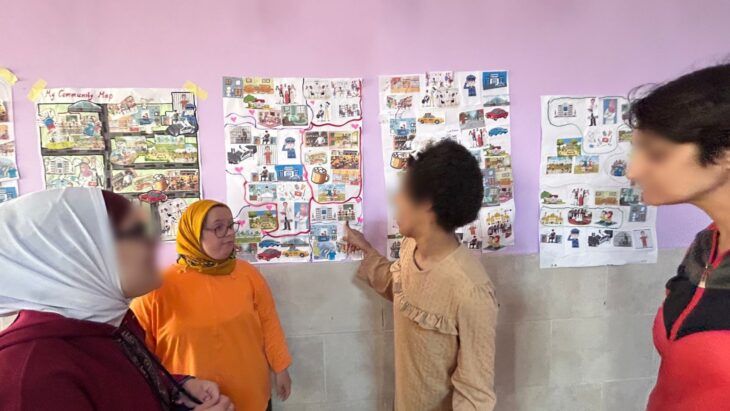
We used our Empower Us programme to support 18 women to look at who they are, how to make choices, and how to see themselves as part of their communities.
Over time, the women grew in confidence and communication. Their progress encouraged others in the centre.
Staff also took part in the training. They learned how to support the women to make their own choices instead of making decisions for them.
Families and community organisations at the centre of change
Inclusion does not stop at the door of an institution. Families play a key role in helping people move back into the community.
Over the summer, eighteen family members joined a three-day training to become trainers themselves.
They will help other families by running support groups, challenging harmful ideas, and guiding relatives as they return to community life.
To make inclusion last, we also worked with community groups and organisations of people with disabilities across Jordan.
We trained them on rights, inclusive participation, and the UN Convention on the Rights of Persons with Disabilities. Later, we supported them to think about how to run services that include everyone.
We also provided direct coaching to two community groups with strong potential. These were White Window and CDC Marka Camp. They received support to plan inclusive services, work with families, and look at income options for people with disabilities.
Sharing learning across Jordan and beyond
Throughout the project, we collected lessons, challenges, and tools. We shared these at advocacy events, including Europe in Action, COSP, the Global Disability Summit, and our World Congress in Sharjah.
Jordan’s work added to global conversations about inclusive care, crisis readiness, and how to close institutions.
We also supported community groups to prepare a report to the UN committee that monitors the disability rights convention.
What comes next
The project has ended, but the results continue.
Staff have new skills. Women in Tafelah have a stronger voice. Family leaders are ready to support others. Community organisations have new tools to make inclusion real.
We have also produced materials, including a new toolkit for community-based services that will help Jordan continue its national plan to close institutions.
The project leaves us with a clear message: what we do before a crisis is what protects people during a crisis.
By investing in people, relationships, and inclusive systems, this work has helped build a Jordan where people with intellectual disabilities can live, belong, and take part in their communities.