On 1 October 2026, Inclusion International and Inclusion Canada hosted “When Disability Becomes a Reason to Die: Lessons from Canada’s MAID Law”, a closed webinar for self-advocates, families and member organisations.
The session grew out of a presentation at our World Congress in Sharjah in September 2025. Members asked for a dedicated space to learn more about how assisted dying laws develop, and how to protect people with disabilities from similar laws in their own countries.
Persons with disabilities deserve the same protection of their lives as everyone else
Krista Carr, CEO of Inclusion Canada at our webinar on Medical Assistance in Dying
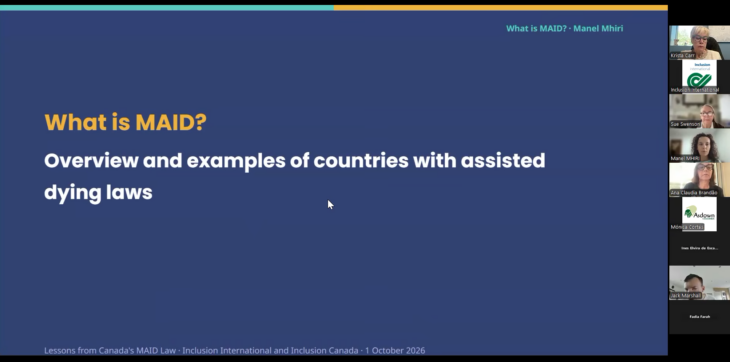
What Is MAID?
Medical Assistance in Dying (MAID) is when a health professional helps a person end their life, following procedures set out in law. It takes two forms: euthanasia, where a health professional gives the lethal medication, and assisted suicide, where the person takes it themselves.
Some form of MAID is now legal in Switzerland, the Netherlands, Belgium, Luxembourg, Spain, Austria and France; in Colombia, Cuba, Ecuador, Uruguay and 14 US states; and in Australia and New Zealand. In some places it is limited to people who are terminally ill. In others it is not.
The numbers are significant. In 2025, MAID accounted for around 6% of all deaths in the Netherlands and 4% in Belgium. In Canada, 16,499 people died through MAID in 2024, or 5.1% of all deaths.
How Canada’s Law Changed
Inclusion Canada has been involved since 2014, when it intervened in the Supreme Court case Carter v. Canada alongside the Council of Canadians with Disabilities. After the court struck down the ban on assisted dying in 2015, disability advocates warned of the risks in a society where people with disabilities already face discrimination and a lack of support. They pushed for any law to be limited to people whose death was near.
Canada’s first MAID law in 2016 did this. It required a person’s natural death to be “reasonably foreseeable”, a route that became known as Track 1.
In 2019, a Quebec court ruled in the Truchon case that this requirement was unconstitutional. The ruling came during a federal election campaign, and neither government appealed. Instead, Parliament rewrote the law.
In 2021, Bill C-7 created Track 2: MAID for people whose death is not reasonably foreseeable. Because people who are not disabled and not terminally ill cannot access MAID in Canada, Track 2 makes disability the qualifying condition. Inclusion Canada calls this “disability-based assisted death”.
Being Told About Support Is Not Support
Under Track 2, assessors must tell applicants about services that could help them. But nothing requires governments to provide those services. A person living in poverty, without secure housing or without the support they need can be told help exists, with no guarantee they will ever receive it.
Being told about a service and being able to get it are very different things, and everybody with disabilities knows all about that.
Krista Carr, CEO of Inclusion Canada at our webinar on Medical Assistance in Dying
Inclusion Canada is clear that governments must meet their obligations on income, housing and care, rather than offering assisted death in place of support.
Where Things Stand
In March 2025, the UN Committee on the Rights of Persons with Disabilities recommended that Canada repeal Track 2. In June 2026, a Canadian parliamentary committee recommended indefinitely excluding mental illness from MAID. But Track 2 remains law, and MAID is set to expand to people whose only condition is a mental illness in March 2027.
Inclusion Canada is calling for the repeal of Track 2, the indefinite exclusion of mental illness, and real investment in housing, income, healthcare and community support.
What Our Network Can Do
- Support Inclusion Canada’s call to repeal Track 2.
- Share verified evidence and follow legal developments in your country.
- Make sure self-advocates are at the centre of every policy discussion on assisted dying.
- Help Inclusion International develop a global network position paper on MAID.
For more information, contact Kurt Goddard at Inclusion Canada (kgoddard@inclusioncanada.ca) or Manel Mhiri at Inclusion International (manel@inclusion-international.org).